

Quick Answer
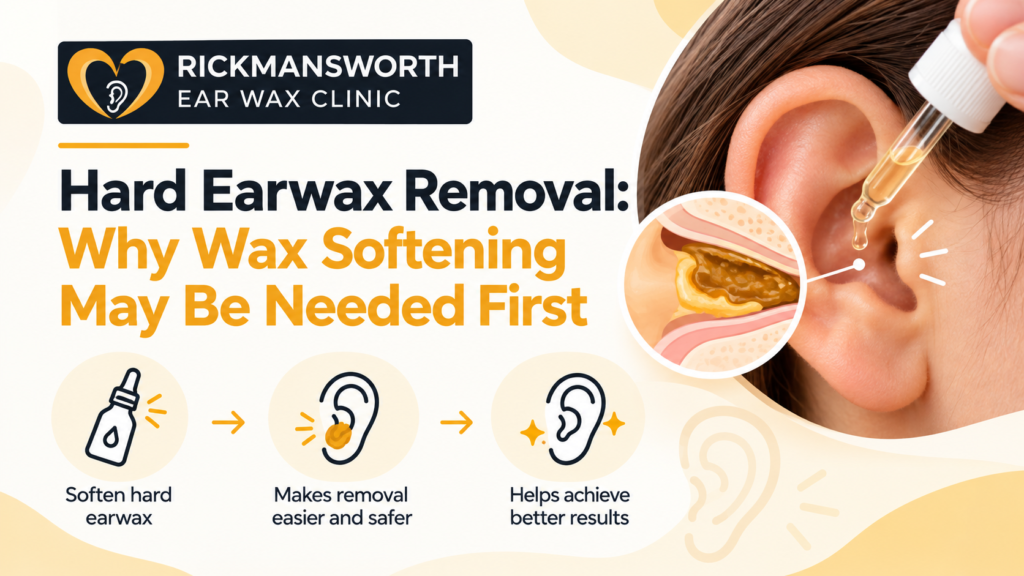
Hard earwax removal can become easier when you soften the wax before treatment. Hard, dry or tightly impacted wax may be more difficult to remove comfortably. Rickmansworth Earwax Clinic suggests suitable patients use olive ear spray for around five days before their appointment to help make microsuction smoother and more effective.
Introduction
Earwax normally protects the ear canal and often clears naturally. However, sometimes it becomes dry, firm or tightly packed inside the canal.
When this happens, hard earwax removal may require some preparation before professional treatment. Trying to force hard wax out can cause unnecessary discomfort, while cotton buds often push it further inside.
At Rickmansworth Earwax Clinic, clinicians first examine the ear and then choose the most suitable removal approach. The clinic also advises suitable patients to use olive ear spray for five days beforehand to soften difficult wax.
Key Takeaways
- Hard wax can become more difficult to remove than soft wax.
- Wax softening may make microsuction more comfortable and effective.
- Rickmansworth Earwax Clinic suggests olive ear spray for five days before treatment where suitable.
- Ear drops are not appropriate for everyone.
- Cotton buds can push hard wax deeper.
- Professional examination should come before removal.
- Hard wax does not always need to come out in one appointment.
Why Can Hard Earwax Removal Need Softening First?
Hard earwax removal may need softening because dry or compacted wax can stick firmly to the ear canal.
As people age, earwax can become drier and harder. Narrow ear canals, hearing aids, earplugs and in-ear headphones can also interfere with natural wax clearance. NHS guidance notes that these factors can increase the chance of blockage.
Therefore, softening the wax beforehand can make it easier to separate from the canal wall.
In addition, softer wax may allow a clinician to remove it more gradually rather than applying repeated suction to one hard piece.
How Does Wax Softening Help?
Wax softeners help by making firm earwax less dry and easier to move.
NICE identifies wax softeners such as olive oil, sodium bicarbonate and water-based preparations as common approaches used before mechanical wax removal.
The NHS also advises that olive or almond oil can soften uncomplicated wax so that it may move out naturally.
At Rickmansworth Earwax Clinic, the preparation advice is more specific: suitable patients should apply olive ear spray for five days before treatment. The clinic says this can make removal smoother and more effective.
Is Wax Softening Always Necessary Before Microsuction?
No. Not everyone needs to soften wax before microsuction.
Some wax may already be soft enough for straightforward removal. However, very hard, dry or deeply impacted wax may benefit from preparation.
NICE specifically recommends pre-treatment wax softeners for electronic irrigation. For microsuction, clinicians should instead choose the method according to the person’s ear, wax and any contraindications.
Therefore, follow the advice given by your ear-care professional rather than assuming every blocked ear needs the same preparation.
Hard Wax vs Soft Wax: What Is the Difference?
Hard and soft wax may behave differently during treatment.
Hard Earwax | Softer Earwax |
Dry and firm | More pliable |
May stick to the canal | Often moves more easily |
Can feel tightly impacted | May be easier to extract |
May need preparation | May need less preparation |
Removal can take longer | Removal may be quicker |
However, the appearance of wax alone does not determine treatment. The clinician also considers its location, the condition of the ear canal and your medical history.
What Happens Before Hard Earwax Removal?
The clinician should examine your ear before deciding how to remove the wax.
Rickmansworth Earwax Clinic starts with an otoscopic inspection. This allows the practitioner to see how much wax has built up and decide which removal method suits the ear.
Next, the team explains the procedure and any relevant risks. After you consent, the clinician can proceed with microsuction where appropriate.
Finally, the clinic provides aftercare advice to help reduce future wax problems.
What If the Wax Is Still Too Hard?
If wax remains too hard, more softening and a later removal attempt may be safer than forcing it.
Hard earwax removal does not always need to finish in one session.
For example, a clinician may stop if the wax remains firmly attached or if continuing would cause unnecessary discomfort. They may then advise additional softening before another appointment.
This approach puts ear safety and comfort ahead of trying to complete treatment at any cost.
Can You Use Olive Oil at Home?
Yes, olive oil can help soften ordinary earwax for many people, but it is not suitable for everyone.
The NHS suggests olive or almond oil for uncomplicated earwax build-up. However, it specifically advises against using drops if you have a perforated eardrum.
Therefore, ask a pharmacist or ear-care professional before using drops if you have:
- Previous ear surgery
- A known or suspected eardrum perforation
- Ear discharge
- Significant ear pain
- A history of serious ear problems
Do not pour large amounts of oil into the ear. Instead, follow the product or professional instructions.
Why Should You Avoid Cotton Buds?
Cotton buds can turn ordinary wax into a harder, deeper blockage.
Rather than pulling wax out, they often push it further down the canal. NICE also warns that small objects can damage the ear canal or eardrum.
Therefore, avoid trying to dig out hard wax yourself.
Clean only the visible outer ear and let a trained professional assess persistent blockage.
When Should You Book Hard Earwax Removal?
Book an ear assessment when wax symptoms persist or start affecting hearing and comfort.
Possible symptoms include muffled hearing, a blocked sensation, earache, tinnitus and dizziness. The NHS lists these among the common symptoms of earwax build-up.
However, do not assume every hearing problem comes from wax.
Sudden hearing loss, significant pain, discharge or bleeding needs appropriate medical assessment rather than routine wax removal.
How Can Rickmansworth Earwax Clinic Help?
Rickmansworth Earwax Clinic provides assessment-led hard earwax removal using microsuction where suitable.
The clinic’s process includes:
- Otoscopic examination.
- Explanation of treatment.
- Microsuction where appropriate.
- Aftercare guidance.
The clinic also suggests olive ear spray for five days before treatment where suitable.
Rickmansworth Earwax Clinic
3 Tudor Way, Berry Lane
Rickmansworth, WD3 4DF
Patients can book an earwax appointment directly with the clinic.
Common Misconceptions
“Hard wax needs stronger suction.”
No. Softening and a careful approach may work better than trying to force dry wax out.
“I should remove hard wax with a cotton bud.”
No. Cotton buds can push it deeper.
“All wax must come out in one visit.”
No. Additional softening and a follow-up appointment may sometimes be more appropriate.
“Olive oil is safe for every ear.”
No. People with perforated eardrums or certain ear conditions need professional advice first.
People Also Ask
Why does earwax become hard?
Age, dry skin, ear-canal shape and reduced natural wax movement can all contribute.
Does hard earwax need softening before microsuction?
Sometimes. Softening may make very dry or impacted wax easier to remove.
How long should I soften earwax before treatment?
Rickmansworth Earwax Clinic suggests olive ear spray for around five days before treatment where suitable.
Can hard earwax affect hearing?
Yes. Impacted wax can cause temporary hearing loss or a blocked sensation.
Where can I get hard earwax removed in Rickmansworth?
Rickmansworth Earwax Clinic provides professional assessment and microsuction where appropriate.
Conclusion
Hard earwax removal often becomes easier when very dry or compacted wax has first been softened.
Therefore, suitable preparation can help make professional treatment smoother and more comfortable. However, not every ear needs drops, and some ear conditions make them unsuitable.
Rickmansworth Earwax Clinic examines the ear first, recommends appropriate preparation and provides microsuction where suitable. If hard wax is causing persistent blockage or hearing changes, professional assessment can help determine the safest next step.
Medical notice: This article provides general ear-health information and does not replace individual clinical assessment.
FAQs
Is hard earwax dangerous?
Usually not, but impacted wax can cause discomfort and hearing problems.
Can hard wax fall out naturally?
Sometimes, especially after suitable softening.
Can olive oil soften hard wax?
Yes. Olive oil can soften wax in suitable ears.
Does microsuction remove hard wax?
It can, although very hard wax may benefit from preparation first.
Does hard earwax removal hurt?
Professional treatment is usually well tolerated, but very hard wax may cause more discomfort.
Can I use cotton buds?
No. They can compact wax further.
What if microsuction cannot remove all the wax?
The clinician may advise more softening and another appointment.
Should my ears be examined first?
Yes. Examination helps confirm that wax is present and guides the safest treatment.
