

Quick Answer
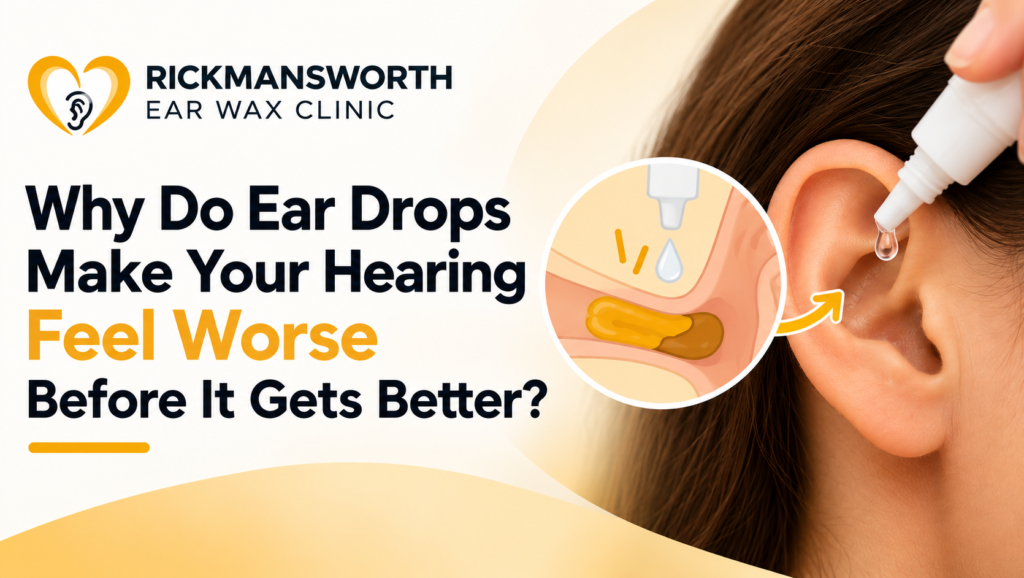
Ear drops can temporarily make your hearing feel worse because the liquid softens and expands compacted earwax before it breaks down or moves out of the ear canal. This can increase the blocked sensation for a short time. However, sudden hearing loss, significant pain, discharge or dizziness should be assessed rather than assumed to be normal earwax.
Introduction
You start using ear drops because your ear feels blocked, but after the first few applications your hearing seems even more muffled. Understandably, this can make you wonder whether the treatment is making the problem worse.
In many cases, a temporary change in hearing after using ear drops for earwax can happen while the wax softens.
As liquid enters the ear canal, dry or compacted wax may absorb some of it, change shape or expand before it begins to break down. This can temporarily make the ear feel fuller and sounds seem quieter.
However, not every change in hearing should automatically be blamed on earwax.
At Rickmansworth Earwax Clinic, patients are assessed before professional removal, and suitable patients may be advised to use olive ear spray before treatment to soften difficult wax.
Key Takeaways
- Ear drops can temporarily make blocked hearing feel worse.
- Wax may expand or change position as it softens.
- Popping or increased fullness can occur during treatment.
- Improvement may take several days rather than happening immediately.
- Do not insert cotton buds to remove softened wax.
- Ear drops are not appropriate for every ear condition.
- Pain, discharge, significant dizziness or sudden hearing loss need assessment.
- Professional microsuction may be appropriate when troublesome wax does not clear.
Why Can Ear Drops Make Hearing Feel Worse?
Ear drops can temporarily reduce hearing because they soften and expand the existing wax before it begins to break down or leave the canal.
Earwax can form a partial or complete plug inside the ear canal. When oil or another wax-softening product reaches that plug, the wax can become softer and slightly larger.
For a short period, this may close more of the ear canal than before.
Sound then has more difficulty travelling through the canal towards the eardrum, which can make hearing seem muffled.
Some people also notice popping, bubbling or a feeling of liquid moving in the ear.
NHS ear-care guidance recognises that temporary hearing changes can occur while wax-softening drops are being used.
Does Worse Hearing Mean the Drops Are Not Working?
Not necessarily. A temporary increase in blockage can be part of the wax-softening process.
Ear drops do not normally remove a hard plug instantly.
Instead, their purpose is to soften the wax so that it can either move out naturally or become easier to remove professionally.
The NHS advises that wax may gradually come out over approximately two weeks after suitable oil drops are used.
Therefore, you should not expect your hearing to become completely clear after the first application.
However, symptoms should not continue worsening indefinitely.
If your ear remains badly blocked, you cannot hear properly or the problem does not improve after the recommended period, arrange an ear examination.
How Do Ear Drops Actually Work?
Wax-softening drops change the consistency of earwax so that it is less hard and compacted.
Different products work in slightly different ways.
Olive oil mainly softens and lubricates the wax. Other preparations, including sodium bicarbonate-based products, are designed to help break wax down.
Once softened, the normal movement of skin inside the ear canal may gradually carry wax towards the ear opening.
Alternatively, softer wax can often be easier for a trained practitioner to remove.
Rickmansworth Earwax Clinic currently recommends suitable patients use olive ear spray for around five days before professional treatment, particularly when wax is hard or dry.
The spray is therefore preparation for treatment rather than a guarantee that every blockage will disappear by itself.
How Long Can Hearing Feel Worse After Ear Drops?
Temporary muffled hearing may occur during the first few days of wax-softening treatment.
The exact duration depends on how much wax is present, how hard it is and whether the ear canal is completely blocked.
Some people notice improvement relatively quickly. Others may need several days before the wax becomes sufficiently soft.
The NHS generally advises using olive or almond oil drops for around three to five days for uncomplicated wax build-up.
However, always follow the specific product instructions or advice given by your pharmacist or clinician.
If the ear becomes completely blocked or symptoms fail to improve, further assessment may be needed.
Temporary Blockage vs Symptoms That Need Assessment
A mild temporary change in hearing can occur with ear drops, but certain symptoms should not be ignored.
Often Temporary During Wax Softening | Seek Medical or Professional Advice |
Mild muffled hearing | Sudden hearing loss |
Feeling more blocked | Severe or increasing pain |
Popping sounds | Ear discharge |
Sensation of liquid | Bleeding |
Mild temporary fullness | Significant or persistent dizziness |
Gradual changes while wax softens | Rapidly worsening hearing |
Sudden hearing loss is particularly important.
The NHS advises urgent GP or NHS 111 assessment if hearing suddenly decreases in one or both ears or becomes noticeably worse over a few days or weeks.
Do not simply continue using ear drops and assume sudden hearing loss is caused by wax.
Should You Keep Using the Drops If Hearing Gets Worse?
A mild temporary blocked sensation may not require you to stop, but painful or unusual symptoms should prompt professional advice.
If you simply notice temporary muffling or popping while the wax softens, continue according to the product instructions unless you have been told otherwise.
However, stop and seek advice if the drops cause pain, significant discomfort, dizziness or skin irritation around the ear.
You should also seek assessment if hearing deteriorates substantially rather than fluctuating mildly.
Cambridge University Hospitals advises stopping drops if pain develops, while other NHS ear-care guidance also recommends seeking advice for dizziness or irritation.
Who Should Be Careful With Ear Drops?
Ear drops are not suitable for everyone, particularly when there may be an eardrum or middle-ear problem.
Do not simply start using drops without professional advice if you have:
- A known or suspected perforated eardrum
- Grommets
- Previous ear surgery
- Ear discharge
- Significant ear pain
- Bleeding
- A suspected infection
- Instructions to keep your ear dry
Rickmansworth Earwax Clinic also advises patients with these circumstances to seek professional guidance before using ear-softening products.
An ear examination can help determine whether wax is actually the cause of the symptoms.
Should You Use Cotton Buds After Ear Drops?
No. Cotton buds can push softened wax deeper into the canal and make the blockage worse.
When wax becomes softer, it may be tempting to try to remove it yourself.
However, inserting a cotton bud can compress the wax closer to the eardrum.
You may remove a little wax from the entrance while pushing the majority further inside.
NICE advises adults not to insert cotton buds or other small objects into the ear canal because they can damage the ear canal or eardrum and worsen wax impaction.
Allow the wax to move naturally or arrange professional removal if symptoms continue.
Why Might One Ear Feel Worse Than the Other?
The ears may contain different amounts or types of wax, so they do not always respond to drops in the same way.
One ear might contain a small amount of soft wax while the other contains a dense plug.
If the heavily blocked ear absorbs the softening product, it may temporarily feel considerably more blocked.
Some NHS ear-care guidance even suggests treating one affected ear at a time when both ears are heavily blocked, because hearing can temporarily worsen during softening.
If both ears are significantly blocked, professional assessment may help you avoid becoming temporarily dependent on one poorly hearing ear.
Can Ear Drops Affect Hearing Aids?
Yes. Ear drops and softened wax can temporarily interfere with hearing-aid performance.
Oil or moisture inside the ear canal may affect the way a hearing aid fits or sounds.
Wax itself can also obstruct the device, reduce sound quality or contribute to whistling.
Some NHS guidance recommends applying drops after removing hearing aids, such as before bed, to reduce interference.
If you wear hearing aids regularly and experience recurrent wax build-up, periodic professional ear checks may be useful.
Do not allow oil to enter the hearing aid itself.
What If Ear Drops Do Not Clear the Wax?
Persistent blockage may need professional earwax removal rather than repeated self-treatment.
Some plugs are simply too hard, large or deeply positioned to clear with drops alone.
If your symptoms persist after appropriate softening, a clinician can examine the ear and determine whether removal is needed.
NICE recognises several professional methods, including microsuction, electronic irrigation and appropriate manual removal when performed by trained practitioners with suitable equipment.
At Rickmansworth Earwax Clinic, microsuction is offered after an ear assessment where appropriate.
The aim is not simply to remove anything visible. The clinician first checks whether wax is actually responsible for the symptoms.
Ear Drops vs Microsuction: What Is the Difference?
Ear drops soften wax, while microsuction physically removes appropriate wax under visual guidance.
Ear drops may be enough for mild uncomplicated build-up.
Microsuction is different because the practitioner examines the canal and uses controlled suction to remove wax while viewing the treatment area.
For hard or impacted wax, drops may actually be used before microsuction to make treatment easier.
Therefore, these are not always competing treatments.
For some patients, the most effective approach is soften first, assess, then remove where necessary.
What If Hearing Does Not Improve After Wax Is Removed?
If hearing remains reduced after successful wax removal, earwax may not have been the only cause.
Other conditions can cause muffled or reduced hearing, including middle-ear problems, infections and different forms of hearing loss.
The NHS recommends seeing a GP if hearing does not return after treatment for earwax build-up.
Depending on the symptoms, a hearing assessment, GP review or referral to another ear-care professional may be appropriate.
This is another reason professional examination is valuable: it reduces the risk of repeatedly treating “earwax” when something else is responsible.
What Are Common Misconceptions About Ear Drops?
“If my hearing becomes worse, the drops have damaged my ear.”
Not necessarily. Temporary hearing reduction can occur because the wax expands as it softens.
“More drops will clear the wax faster.”
No. Follow the recommended amount and frequency. Using excessive products does not guarantee faster treatment.
“I should use cotton buds once the wax becomes soft.”
No. Cotton buds may push softened wax deeper.
“Drops should clear every blocked ear.”
No. Some impacted wax requires professional removal, while some blocked-ear symptoms are not caused by wax at all.
“Sudden hearing loss is probably just earwax.”
Never assume this. Sudden or rapidly worsening hearing needs urgent medical assessment.
How Can Rickmansworth Earwax Clinic Help?
Rickmansworth Earwax Clinic can determine whether earwax is actually causing your muffled or blocked hearing and provide microsuction where suitable.
The clinic uses an assessment-first approach.
Your symptoms and relevant ear history are reviewed before the ear canal is examined. Where wax removal is appropriate, microsuction can then be performed under visual guidance.
Suitable patients are advised to use olive ear spray for around five days before treatment to soften hard wax.
If wax remains too difficult to remove comfortably, the practitioner may recommend further softening and another appointment rather than forcing removal.
Rickmansworth Earwax Clinic
3 Tudor Way, Berry Lane
Rickmansworth
WD3 4DF
The clinic also provides an at-home service using video otoscopy and microsuction for suitable patients.
People Also Ask
Why has my hearing become worse after using ear drops?
The drops may temporarily expand or reposition compacted wax as they soften it, making the ear feel more blocked.
Is it normal for ears to feel blocked after olive oil drops?
Yes, temporary fullness or muffled hearing can occur while the wax softens.
How long do ear drops take to work?
Suitable wax-softening drops are often used for several days. Wax may then gradually move out over the following days.
Should I stop ear drops if my hearing gets worse?
Mild temporary muffling can occur, but stop and seek advice if you develop pain, significant dizziness, irritation or rapidly worsening hearing.
Can ear drops push wax deeper?
The drops themselves soften wax. Cotton buds or other objects used afterwards are more likely to push it deeper.
What if ear drops do not work?
A professional ear examination can determine whether microsuction or another treatment is appropriate.
Conclusion
Ear drops can sometimes make hearing feel worse before it gets better because earwax may expand or change position while it softens.
A short period of muffled hearing, fullness or popping can therefore occur during appropriate wax-softening treatment.
However, the symptoms should not simply be ignored if they become severe or continue.
Avoid cotton buds and other objects, follow the recommended instructions and seek professional advice if the blockage does not improve.
Most importantly, sudden or rapidly worsening hearing loss, significant pain, discharge, bleeding or dizziness requires appropriate medical assessment rather than continued self-treatment.
For persistent blocked ears and professional microsuction in Rickmansworth, contact Rickmansworth Earwax Clinic for an ear examination and personalised advice.
Frequently Asked Questions
Can olive oil make earwax blockage feel worse?
Temporarily, yes. Wax can expand as it absorbs the oil and softens.
Can ear drops cause popping sounds?
Yes. Some people notice popping or changing sounds while liquid interacts with the wax.
How many days should I use ear drops?
Follow the product or clinician’s instructions. NHS self-care guidance commonly recommends several days for uncomplicated wax.
Can I use drops with a perforated eardrum?
Do not use ear drops without professional advice if you have a known or suspected perforated eardrum.
Should I put cotton wool in after using drops?
Usually no. It can absorb the drops and may interfere with the treatment.
Can hearing aids make earwax worse?
Hearing aids can interfere with natural wax movement in some people and may contribute to recurring build-up.
When should I worry about worsening hearing?
Seek urgent advice for sudden or rapidly worsening hearing, particularly with pain, discharge or other concerning symptoms.
Where can I get earwax removal in Rickmansworth?
Rickmansworth Earwax Clinic provides ear examination and professional microsuction at its Tudor Way clinic.
