

Quick Answer
Neither microsuction nor ear irrigation is universally better for every patient. Microsuction removes wax under direct visual guidance without flushing water into the ear, while irrigation uses controlled water flow to wash softened wax out. The safest option depends on your ear history, wax type, eardrum condition and professional assessment.
Introduction
If earwax is causing blocked ears, muffled hearing or discomfort, you may be wondering whether microsuction or ear irrigation is the better way to remove it.
Both methods are used in UK ear care, but they work very differently.
Microsuction uses a small suction device while the practitioner views the ear canal. Irrigation uses a controlled stream of water to flush softened wax from the ear.
Importantly, NICE does not state that one method is universally superior. Comparative evidence remains limited, and the right treatment depends on the individual ear.
At Rickmansworth Earwax Clinic, clinicians examine your ears first and provide microsuction where it is suitable.
Key Takeaways
- Microsuction removes wax using controlled suction.
- Ear irrigation uses water to flush softened wax from the canal.
- Microsuction allows the practitioner to view the wax during removal.
- Irrigation is not suitable for everyone.
- Previous perforation, ear surgery or infection can affect treatment choice.
- Wax softening may be recommended before either procedure.
- Neither treatment should be performed routinely when wax is not causing a problem.
- Professional assessment should come before choosing a removal method.
What Is Microsuction Earwax Removal?
Microsuction removes earwax using a small suction probe while the clinician views the ear canal.
Before treatment, the practitioner examines the ear to check the amount, location and consistency of the wax.
The suction probe is then carefully positioned to remove wax and debris.
Because the practitioner can see inside the ear during treatment, the procedure can be adjusted according to the position of the wax and the patient’s comfort.
Microsuction does not require water to be flushed through the ear.
At Rickmansworth Earwax Clinic, microsuction is provided after a patient-history review and otoscopic examination.
What Is Ear Irrigation?
Ear irrigation removes softened wax by gently flushing the ear canal with controlled water pressure.
Modern professional irrigation uses an electronic irrigator designed specifically for ear care.
This should not be confused with traditional manual ear syringing.
NICE advises against manual syringing for earwax removal and instead recommends an electronic irrigator when irrigation is appropriate.
Wax-softening drops are usually used before irrigation. This helps loosen the wax so it can move out more easily when water is introduced.
Irrigation can work well for suitable patients, but certain ear conditions can make it inappropriate.
Microsuction vs Ear Irrigation: What’s the Difference?
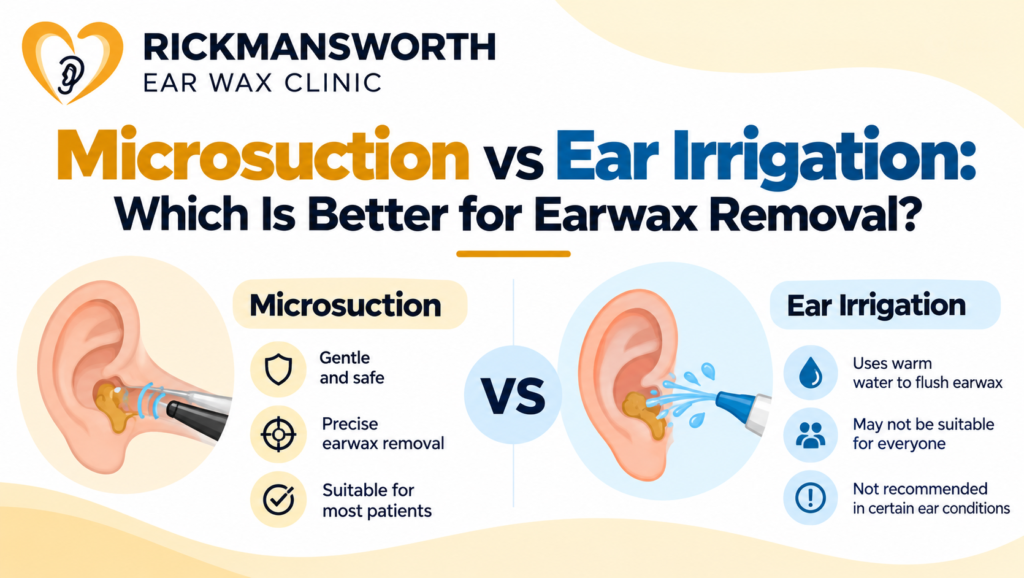
The main difference is that microsuction uses suction under visual guidance, while irrigation uses water to flush wax out.
Microsuction | Ear Irrigation |
Uses controlled suction | Uses controlled water flow |
No water flushed into the ear | Water enters the ear canal |
Wax viewed during removal | Wax flushed from the canal |
Can suit some people who cannot have irrigation | Not suitable with certain ear histories |
May sound loud | Usually quieter |
Temporary dizziness can occur | Temporary dizziness can occur |
Performed by trained practitioners | Should use a professional electronic irrigator |
The choice should be made after assessing the individual ear rather than simply choosing whichever method sounds more convenient.
Is Microsuction Better Than Irrigation?
Microsuction has several practical advantages, but current evidence does not prove that it is better for every patient.
One important advantage is direct visual guidance. The clinician can see the wax and surrounding ear canal while removing it.
Microsuction also avoids introducing water into the ear.
This may make it a useful option for some people who are not suitable for irrigation because of their ear history.
However, microsuction can be noisy and some people find the sound uncomfortable.
Therefore, the correct question is usually not “Which method is always better?” but rather “Which method is appropriate for my ears?”
When Might Microsuction Be Preferred?
Microsuction may be considered when irrigation is unsuitable or when controlled removal under direct vision is preferred.
NHS guidance indicates that irrigation is not advised for some patients with a history of:
- Eardrum perforation
- Previous ear surgery
- Certain recurrent ear infections
- Other significant ear problems
Microsuction may be an option in some of these circumstances, depending on professional assessment.
It can also be useful when the clinician wants to remove wax without introducing water into the canal.
However, previous surgery or a perforation does not automatically mean every case is suitable for routine microsuction. More complex ears may require specialist ENT care.
When Might Ear Irrigation Be Suitable?
Ear irrigation can be effective for adults with softened wax who do not have contraindications to the procedure.
NICE recognises electronic irrigation as an appropriate earwax-removal method in primary or community care.
Before irrigation, wax-softening products are normally used either immediately beforehand or for several days.
The method may be suitable when the wax can be safely flushed out and there is no relevant history of perforation, infection or certain previous ear operations.
If irrigation fails repeatedly, NICE recommends considering specialist ear care rather than continuing repeated attempts.
Does Microsuction Hurt?
Microsuction is generally well tolerated, although some people experience noise, pressure or temporary discomfort.
Because the suction probe operates inside the ear canal, the procedure can sound surprisingly loud.
Some patients may experience temporary dizziness, particularly if temperature changes occur inside the ear.
Rarely, patients report temporary tinnitus, noise sensitivity or changes in hearing.
A trained practitioner should monitor your comfort throughout the treatment.
If you feel pain, dizziness or need a break, tell the clinician. The procedure can be paused.
Does Ear Irrigation Hurt?
Ear irrigation should not normally be painful when performed correctly on a suitable patient.
You may notice the sensation of water moving around the ear canal.
Some people can experience temporary dizziness, discomfort or irritation.
Problems are more likely when irrigation is attempted despite an unsuitable ear history or when inappropriate pressure is used.
This is why professional assessment is important before treatment.
If severe pain, significant dizziness or sudden hearing changes occur during or after irrigation, medical assessment may be required.
Which Method Is Safer?
Both methods can be performed safely by trained professionals when used appropriately.
Microsuction and irrigation both carry potential risks.
Microsuction risks can include temporary discomfort, dizziness, tinnitus or sensitivity to noise.
Irrigation can potentially cause irritation, infection, dizziness or damage to the ear canal or eardrum.
However, the biggest safety factor is often patient selection.
Using the right method for the right ear is more important than assuming one technique is always safest.
NICE therefore emphasises appropriate equipment, practitioner training and awareness of contraindications.
Do You Need to Soften Wax Before Microsuction?
Softening hard wax before treatment can make removal easier and more comfortable.
Microsuction can sometimes remove wax without extensive preparation, but very hard or impacted wax may be difficult to remove safely.
At Rickmansworth Earwax Clinic, patients may be advised to soften difficult wax before treatment where appropriate.
If the wax is too hard to remove comfortably, further softening may be recommended rather than forcing the procedure.
Ear irrigation also generally relies on wax-softening treatment before flushing.
Is Microsuction Better for Sensitive Ears?
Microsuction may suit some people with sensitive ears because it avoids flushing the canal with water, but it is not automatically comfortable for everyone.
Sensitive ears may react to sound, touch or movement inside the canal.
Some people prefer microsuction because it is controlled and water-free. Others may find the noise unpleasant.
The practitioner can pause treatment if you become uncomfortable.
For very hard wax, additional softening may make any professional removal method more comfortable.
What Are Common Misconceptions?
“Microsuction is always safer than irrigation.”
Not necessarily. Both can be safe when used appropriately by trained practitioners.
“Irrigation is the same as old-fashioned ear syringing.”
No. Modern electronic irrigation uses purpose-designed equipment. NICE advises against manual ear syringing.
“Microsuction never causes dizziness.”
Some people can experience short-lived dizziness during treatment.
“Irrigation works for everyone.”
No. Certain ear conditions and previous ear surgery can make irrigation unsuitable.
“Every blocked ear needs wax removal.”
No. Infection, pressure changes and other hearing problems can also cause a blocked sensation.
Which Method Should You Choose?
Choose the method recommended after a proper ear examination rather than deciding from online information alone.
If you have no relevant ear problems and your wax has been softened, irrigation may be suitable.
If irrigation is contraindicated or a practitioner prefers controlled removal under direct vision, microsuction may be considered.
In some cases, manual removal using specialist instruments may also be appropriate.
The best approach depends on:
- Your ear history
- Eardrum condition
- Previous surgery
- Wax consistency
- Ear canal anatomy
- Previous infections
- Patient comfort
This is why assessment should come before treatment.
How Does Rickmansworth Earwax Clinic Approach Earwax Removal?
Rickmansworth Earwax Clinic uses an assessment-first approach and provides microsuction where suitable.
The appointment begins with a review of your ear history.
The clinician then examines the ear canal and eardrum with an otoscope to determine whether wax is present and whether removal is appropriate.
Where suitable, professional microsuction is then used to remove the wax.
The clinic also provides personalised ear-care advice and an at-home service using video otoscopy and microsuction for suitable patients.
Rickmansworth Earwax Clinic
3 Tudor Way, Berry Lane
Rickmansworth
WD3 4DF
If your ears feel blocked or your hearing is muffled, booking an examination can help determine whether wax is actually responsible.
People Also Ask
Is microsuction better than ear irrigation?
Not for everyone. Microsuction avoids water and works under visual guidance, while irrigation can be effective for suitable patients with softened wax.
Which earwax removal method is safest?
The safest method depends on your medical and ear history. Professional assessment is more important than choosing one method universally.
Does microsuction use water?
No. Microsuction removes wax using controlled suction.
Is ear irrigation safe?
It can be safe when performed professionally in suitable patients, but it is not recommended for certain ear conditions.
Can you have irrigation with a perforated eardrum?
Irrigation is generally contraindicated when there is a known or suspected eardrum perforation.
Can microsuction cause dizziness?
Temporary dizziness can occur, although it usually settles quickly.
Conclusion
When comparing microsuction vs ear irrigation, neither method is automatically better for every patient.
Microsuction offers controlled, water-free removal under direct visual guidance. Ear irrigation can also be effective when wax has been softened and there are no contraindications.
The safest choice depends on your ear history, eardrum condition, wax consistency and professional examination.
Previous perforation, ear surgery or infection can make irrigation inappropriate, while complex ear conditions may require specialist assessment regardless of the removal method.
For professional ear assessment and microsuction in Rickmansworth, contact Rickmansworth Earwax Clinic at 3 Tudor Way, Berry Lane.
Frequently Asked Questions
Is microsuction painful?
Most people tolerate it well, although some experience noise, pressure or mild discomfort.
Is irrigation painful?
It should not normally be painful when performed correctly in a suitable patient.
Which method is faster?
Treatment time varies according to the amount and consistency of the wax rather than the method alone.
Does microsuction work on hard wax?
It can, although very hard wax may need softening first.
Why is irrigation unsuitable after ear surgery?
Previous surgery can alter the ear, and introducing water may create additional risks in some patients.
Is manual ear syringing still recommended?
No. NICE advises against traditional manual ear syringing.
What if neither treatment removes the wax?
Further softening, another professional method or specialist ENT assessment may be appropriate.
Where can I get microsuction in Rickmansworth?
Rickmansworth Earwax Clinic provides professional ear assessment and microsuction at its Tudor Way clinic.
