
Quick Answer
At-home vs in-clinic earwax removal mainly differs in location and convenience. Both can involve professional ear assessment and microsuction when suitable. Home visits may suit people with mobility difficulties or busy schedules, while clinic appointments suit patients comfortable travelling to the practice. Your symptoms and ear health should guide the decision.
Introduction
Blocked ears, muffled hearing or uncomfortable pressure can make everyday conversations difficult. Once you decide to seek professional help, the next question may be whether to book a home visit or attend a clinic.
At Rickmansworth Earwax Clinic, both options are available. The clinic offers professional in-clinic assessment and microsuction, while its at-home service uses portable ear-care technology to provide treatment in a patient’s home.
Understanding at-home vs in-clinic earwax removal can help you choose an option that fits your health needs and circumstances.
Key Takeaways
- Both options should begin with an assessment of the ear.
- Microsuction may be available at home or in the clinic.
- Home visits offer greater convenience and accessibility.
- Clinic appointments provide treatment in a dedicated clinical setting.
- Mobility, travel and personal comfort can influence your choice.
- Not every blocked ear is caused by wax.
- Severe pain, discharge or sudden hearing loss needs medical assessment.
What Is At-Home Earwax Removal?
At-home earwax removal brings professional ear assessment and treatment to your home.
Rickmansworth Earwax Clinic’s At-Home Service uses the portable Tympa Health system, video otoscopy and microsuction. The service is designed particularly for people who may find travelling to the clinic difficult.
It can be useful for:
- Older adults
- People with reduced mobility
- Busy individuals
- Patients who feel more comfortable at home
- People who depend on carers or family for transport
The important point is that a home visit is still a professional appointment rather than DIY ear cleaning.
What Is In-Clinic Earwax Removal?
In-clinic earwax removal takes place at the clinic following examination of the ear canal.
Rickmansworth Earwax Clinic’s consultation process begins with an otoscopic inspection. The clinician explains the findings and proposed treatment before microsuction is performed where suitable.
The clinic is located at:
3 Tudor Way, Berry Lane
Rickmansworth
WD3 4DF
Patients who can travel easily may prefer having their examination and treatment in a dedicated clinic environment.
At-Home vs In-Clinic Earwax Removal: What Is the Difference?
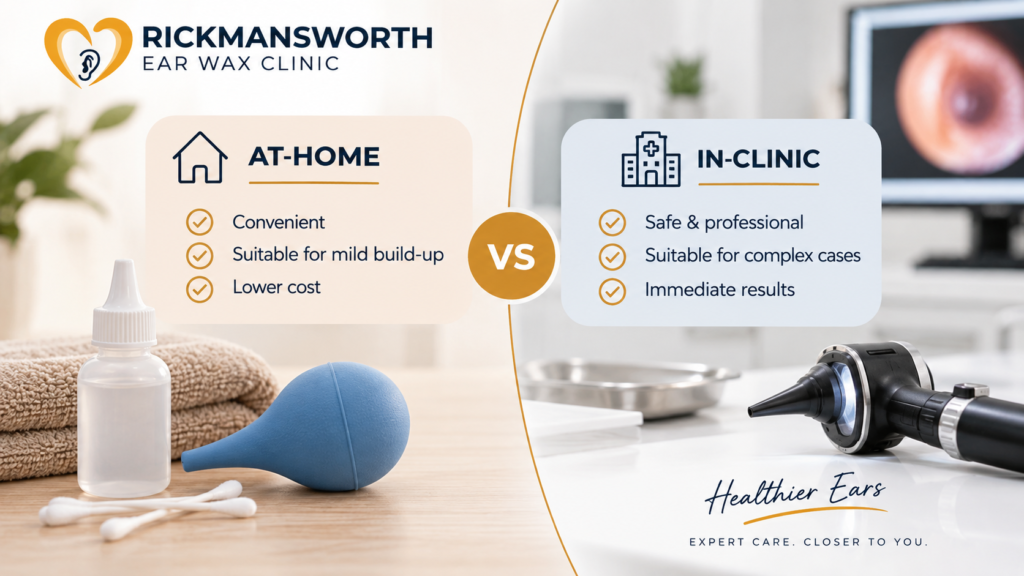
Both services aim to assess the ear and safely manage troublesome wax, but the setting and convenience differ.
Factor | At-Home | In-Clinic |
Location | Your home | Rickmansworth clinic |
Travel required | No | Yes |
Ear examination | Yes | Yes |
Microsuction | Available where suitable | Available where suitable |
Best suited to | Mobility or access needs | Patients able to attend |
Main advantage | Convenience | Dedicated clinical setting |
Neither option should be chosen simply because it sounds quicker. Your ear should first be assessed to confirm that wax is actually causing the problem.
When Might At-Home Earwax Removal Be Better for You?
A home visit may be more practical when travelling to the clinic is difficult.
This can apply if you have limited mobility, depend on someone else for transport, care for another person or simply find a home appointment easier to manage.
Rickmansworth Earwax Clinic states that its mobile service combines video otoscopy with microsuction, allowing professional ear care to be provided at home.
When Might an In-Clinic Appointment Suit You?
An in-clinic appointment may suit you if you can travel comfortably and prefer attending a dedicated healthcare setting.
The consultation includes an ear examination, explanation of treatment and microsuction when appropriate. If the wax is too hard to remove safely, the clinic may recommend further wax softening rather than forcing removal.
The clinic currently recommends olive ear spray for around five days before treatment where suitable.
Is Microsuction Different at Home and in the Clinic?
The principle of microsuction is the same: wax is removed using a fine suction probe while the clinician can see the ear canal.
Professional equipment and practitioner training are more important than the location itself.
NICE recommends earwax removal in primary or community ear-care services when wax is causing symptoms or preventing examination. Suitable methods can include microsuction, electronic irrigation or professional manual removal when the practitioner has appropriate training and equipment.
When Should Earwax Removal Be Avoided?
Do not assume every blocked or painful ear simply needs wax removal.
Seek medical advice if you have:
- Sudden or rapidly worsening hearing loss
- Significant ear pain
- Discharge or bleeding
- Severe or persistent dizziness
- Signs of infection
- Recent ear injury
These symptoms may have causes other than earwax and need appropriate assessment.
What Should You Avoid Doing at Home?
Professional home treatment is different from trying to remove wax yourself.
Avoid putting cotton buds, hairpins, ear picks or similar objects into the ear canal. They can push wax further inside or damage the ear canal and eardrum.
The NHS also states that ear candles and home ear-vacuum devices have no evidence of effectively removing earwax.
How Do You Choose the Right Option?
Choose based on your symptoms, mobility, availability and personal circumstances.
Consider at-home treatment if: travelling is difficult, mobility is limited or home care is significantly more convenient.
Consider in-clinic treatment if: you can attend easily and prefer treatment in the clinic.
If you are unsure, contact Rickmansworth Earwax Clinic and explain your symptoms before booking.
Common Misconceptions
“Home earwax removal means DIY treatment.”
No. Professional home visits involve a trained clinician and specialist equipment.
“Clinic treatment is automatically more effective.”
Not necessarily. Suitability depends on the wax, condition of the ear and professional assessment.
“Every blocked ear needs microsuction.”
No. Blockage may have another cause, so examination comes first.
“Cotton buds are a good alternative.”
No. They can push wax deeper and potentially injure the ear.
People Also Ask
Is professional earwax removal available at home?
Yes. Rickmansworth Earwax Clinic offers a home service using video otoscopy and microsuction where suitable.
Is microsuction safe at home?
It can be performed at home by an appropriately trained professional using suitable equipment after assessment.
Is clinic earwax removal painful?
Microsuction is often well tolerated, although hard or sensitive wax can sometimes cause temporary discomfort.
Who benefits most from home visits?
People with mobility difficulties, older patients, busy individuals and those who find travelling difficult may particularly benefit.
How do I book earwax removal in Rickmansworth?
You can use the clinic’s appointment form or contact the clinic.
Conclusion
Choosing between at-home vs in-clinic earwax removal is mainly about finding a professional service that fits your needs.
Home visits provide convenience and accessibility, while clinic appointments provide treatment at Rickmansworth Earwax Clinic’s dedicated location. Both should involve proper assessment before microsuction or another treatment is considered.
Medical notice: This article provides general ear-health information and does not replace personalised medical assessment.
FAQs
Do both options include an ear check?
Yes. The ear should be examined before deciding whether wax removal is suitable.
Does at-home treatment use microsuction?
Rickmansworth Earwax Clinic states that its home service uses video otoscopy and microsuction.
Does microsuction use water?
No. Microsuction removes wax using controlled suction.
Should I soften wax first?
The clinic recommends olive ear spray for around five days beforehand where suitable.
Can elderly people choose a home appointment?
Yes. Home visits may be particularly convenient for older patients with mobility difficulties.
What if the wax cannot be removed?
Further softening or a follow-up appointment may be advised.
Can I use cotton buds instead?
No. Cotton buds may compact the wax and injure the ear.
Which option should I book?
Choose according to mobility, convenience and your circumstances. The clinic can advise if you are uncertain.
