

Quick Answer
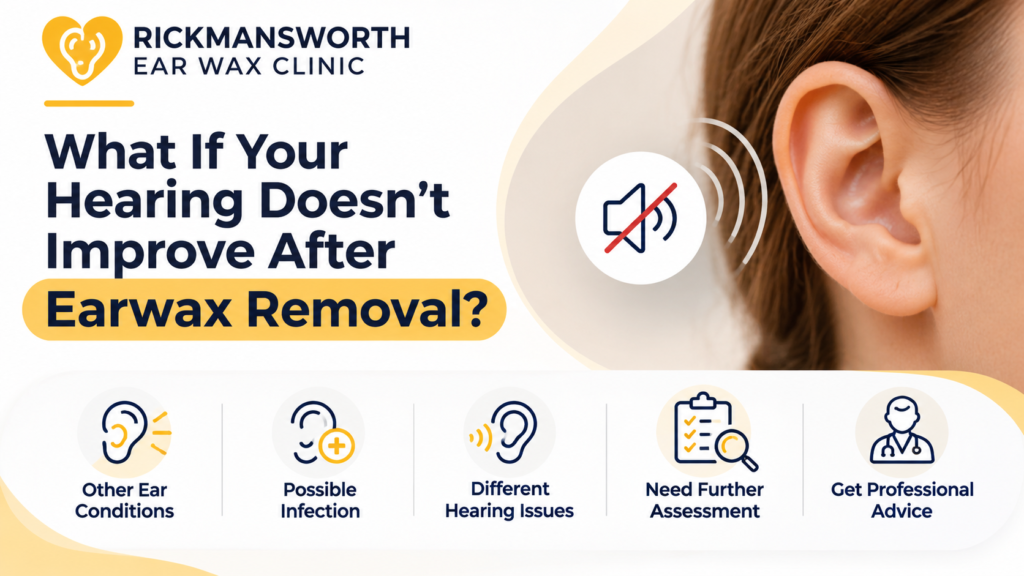
If your hearing does not improve after earwax removal, the wax may not have been the only cause. Residual wax, ear infection, middle-ear pressure or underlying hearing loss may be responsible. Persistent hearing problems should be reassessed, while sudden or rapidly worsening hearing loss requires urgent medical attention.
Introduction
Earwax removal often improves hearing when impacted wax is blocking the ear canal. However, some people find that their hearing still feels muffled even after the wax has been successfully removed.
If your hearing does not improve after earwax removal, another ear or hearing problem may be present. A follow-up examination can help determine whether wax remains or whether further medical or hearing assessment is needed.
Rickmansworth Earwax Clinic provides otoscopic ear examination and professional microsuction where appropriate, with guidance on further care when symptoms continue.
Key Takeaways
- Hearing often improves when impacted wax is successfully removed.
- Some wax may occasionally remain after the first treatment.
- Temporary hearing changes can occur after microsuction.
- Ear infections and middle-ear problems can also reduce hearing.
- Age-related or noise-related hearing loss will not disappear after wax removal.
- Persistent hearing loss should be reassessed.
- Sudden hearing loss requires urgent medical attention.
- Avoid repeatedly treating the ear for wax without another examination.
Should Hearing Improve Immediately After Earwax Removal?
Hearing often improves quickly when earwax was the main cause of the problem.
Impacted wax can physically block sound from travelling through the ear canal. Once that blockage is removed, many people notice clearer hearing.
However, the improvement may not always be immediate. The ear can occasionally feel unusual for a short period after microsuction.
If there is little or no improvement after the ear canal has been cleared, another cause should be considered.
Could Some Earwax Still Be Present?
Yes. Residual earwax is one possible reason hearing remains muffled.
Very hard or deeply positioned wax may not always be safe to remove completely during one appointment. Trying to force difficult wax out could irritate the ear canal or eardrum.
A follow-up ear examination can confirm whether any blockage remains.
If wax is still present, the clinician can decide whether further softening or another removal appointment is appropriate.
Can Microsuction Temporarily Affect Hearing?
Yes. Temporary hearing changes can occasionally happen after microsuction.
Current NHS hospital guidance notes that some patients experience a temporary reduction in hearing, increased tinnitus or sensitivity to sound after the procedure. For most people, these effects are short-lived.
Microsuction can also sound very loud because the suction device operates inside the ear canal.
If hearing remains noticeably reduced rather than gradually returning to normal, further assessment is recommended.
Could the Ear Canal Be Irritated?
Yes. Minor irritation inside the ear canal can sometimes make hearing or ear sensations feel different after treatment.
The skin lining the ear canal is delicate. Hard wax may also be attached closely to the canal wall, making removal more difficult.
Temporary soreness or fullness can occur.
Avoid inserting cotton buds or other objects into the ear after treatment, as this may cause further irritation.
Could an Ear Infection Be Causing the Hearing Loss?
Yes. Ear infections can cause reduced hearing even when the ear canal is free of wax.
Possible symptoms include earache, discharge, itching, pressure or fever.
An outer-ear infection may cause swelling in the ear canal, while a middle-ear infection can interfere with sound transmission behind the eardrum.
If hearing loss is accompanied by pain or discharge, seek medical assessment rather than assuming more earwax needs removing.
Could Middle-Ear Pressure Be the Problem?
Yes. Pressure behind the eardrum can make hearing sound muffled even when the ear canal is completely clear.
One common cause is Eustachian tube dysfunction. The Eustachian tube connects the middle ear to the back of the nose and helps control pressure.
Colds, allergies and sinus congestion can interfere with this process.
People may notice fullness, popping, clicking or hearing that feels as though they are underwater.
Could There Be Fluid Behind the Eardrum?
Yes. Middle-ear fluid can reduce hearing without any wax being present.
Fluid may develop after a cold, respiratory infection or problems with Eustachian tube function.
An ear examination can sometimes show signs of fluid behind the eardrum.
Persistent middle-ear fluid, particularly in adults, may require further medical assessment.
Earwax Hearing Loss vs Other Hearing Loss
Wax-related hearing loss is usually temporary, while other types may continue after the ear canal has been cleared.
Earwax-Related Hearing Loss | Other Hearing Loss |
Wax visible in ear canal | Ear canal may be clear |
Often causes blocked feeling | May occur without fullness |
Usually temporary | May be temporary or permanent |
Often improves after removal | Persists after wax removal |
May affect one ear | Can affect one or both ears |
Treated by wax removal | May need hearing or medical assessment |
An examination is important because symptoms alone cannot reliably identify the cause.
Could You Have Age-Related Hearing Loss?
Yes. Earwax may sometimes make an existing age-related hearing problem more noticeable.
Age-related hearing loss usually develops gradually and often affects both ears.
Removing wax may improve part of the hearing problem but not restore hearing completely.
If conversations remain unclear or you continue turning up the television after wax removal, a hearing test may be appropriate.
Can Loud Noise Cause Hearing Loss That Wax Removal Cannot Fix?
Yes. Repeated exposure to loud noise can damage hearing independently of earwax.
People who work in noisy environments, regularly attend loud music events or use headphones at high volumes may develop permanent hearing loss.
Wax removal cannot reverse damage to the inner ear.
A hearing assessment can help identify whether noise-related hearing loss is present.
Could Tinnitus Affect How You Perceive Hearing?
Yes. Tinnitus can make hearing difficulties feel more noticeable.
Tinnitus is the perception of ringing, buzzing or other sounds without an external source.
Earwax can sometimes contribute to tinnitus, but tinnitus may continue after the wax has been removed if another cause is responsible.
Persistent one-sided or pulsating tinnitus should be assessed appropriately.
What If Only One Ear Still Has Poor Hearing?
Persistent hearing loss in one ear deserves further assessment after wax has been excluded.
One-sided symptoms can sometimes have simple explanations such as infection or pressure problems.
However, NICE recommends further investigation in certain cases of asymmetric or unexplained hearing loss.
Do not repeatedly treat one ear for wax when examination shows the canal is clear.
Should You Have a Hearing Test?
A hearing test is appropriate when hearing difficulties continue after impacted wax and acute infection have been excluded.
NICE recommends audiological assessment for adults with hearing difficulties once these treatable causes have been addressed.
A hearing test measures how well you hear different tones and speech.
The results can help determine whether the problem is conductive, sensorineural or a combination of both.
What Happens During a Hearing Assessment?
A hearing assessment examines how well different parts of your hearing system are working.
An audiologist may perform pure-tone audiometry to measure the quietest sounds you can hear at different frequencies.
Other tests may assess middle-ear function or speech understanding.
If permanent hearing loss is identified, further advice may include hearing aids, monitoring or referral depending on the results.
Should You Use More Ear Drops?
Do not automatically use more ear drops when an examination shows the wax has already been removed.
Wax-softening drops only help when earwax is actually present.
They will not treat inner-ear hearing loss, middle-ear fluid or Eustachian tube dysfunction.
Repeated unnecessary use may also delay appropriate assessment of the true cause.
Should You Try Cleaning Your Ear Again?
No. Do not insert cotton buds, fingers or tools into the ear to investigate persistent hearing loss.
The NHS advises against inserting objects into the ear because they can push wax deeper and damage the ear canal or eardrum.
If you are unsure whether wax remains, arrange another professional examination.
Seeing inside the canal is more reliable than attempting to clean it yourself.
How Long Should You Wait Before Getting Checked?
Persistent hearing problems should be reviewed rather than simply waiting indefinitely for them to improve.
A brief unusual sensation immediately after microsuction may settle, particularly if the ear canal has been irritated.
However, the NHS advises seeing a GP when hearing has not returned after treatment for earwax or an ear infection.
If your hearing remains significantly reduced, arrange appropriate follow-up.
When Is Hearing Loss Urgent?
Sudden or rapidly worsening hearing loss requires urgent assessment.
Contact NHS 111 or request an urgent GP appointment if you suddenly lose hearing in one or both ears.
Hearing that becomes noticeably worse over several days or weeks also needs prompt assessment.
Do not assume sudden hearing loss is caused by recurring wax, even if you have experienced earwax problems before.
What Other Symptoms Need Attention?
Hearing loss combined with certain symptoms should be medically assessed.
Seek advice if you develop significant ear pain, discharge, bleeding, persistent dizziness or worsening tinnitus.
Facial weakness, severe neurological symptoms or sudden hearing loss require particularly urgent assessment.
The correct treatment depends on the cause rather than the hearing symptom alone.
What Are Common Mistakes After Earwax Removal?
The most common mistake is assuming persistent hearing loss means more wax must still be present.
This can lead to repeated drops, cotton-bud use or unnecessary wax-removal attempts.
Another mistake is delaying a hearing test because the person expects hearing to eventually return.
If the canal is clear and hearing remains reduced, the next step is assessment rather than repeated ear cleaning.
Common Misconceptions
Hearing should always return completely after wax removal
No. Hearing will improve only to the extent that earwax was causing the problem.
If hearing is still muffled, some wax must remain
Not necessarily. Infection, middle-ear pressure or underlying hearing loss can cause similar symptoms.
More ear drops will restore hearing
Only if earwax is still present and drops are appropriate.
Permanent hearing loss always affects both ears equally
No. Hearing loss can sometimes be asymmetric.
Sudden hearing loss can wait until another wax appointment
No. Sudden hearing loss requires urgent medical assessment.
What Should You Do Next?
The next step is to confirm that the ear canal is clear and identify whether another condition may be responsible.
A professional examination can check for remaining wax, irritation, infection and visible problems with the eardrum.
If the ear looks clear but hearing remains poor, a GP or audiology assessment may be recommended.
This avoids unnecessary repeat wax removal and helps identify the true cause sooner.
How Can Rickmansworth Earwax Clinic Help?
Rickmansworth Earwax Clinic can reassess your ears if hearing has not improved as expected after wax removal.
The clinic’s process includes patient-history review, otoscopic examination and microsuction where wax is present and treatment is appropriate.
If the canal is clear and your symptoms suggest another hearing problem, the clinic states that it can provide guidance on further support or referral to appropriate ear-care professionals.
Rickmansworth Earwax Clinic
3 Tudor Way, Berry Lane
Rickmansworth
WD3 4DF
An at-home earwax removal service using video otoscopy and microsuction is also available for suitable patients.
People Also Ask
Why is my hearing still muffled after earwax removal?
Possible reasons include remaining wax, temporary irritation, infection, middle-ear pressure or underlying hearing loss.
How long does hearing take to return after microsuction?
Many people notice improvement quickly, although temporary hearing changes can occasionally occur for a short period.
Can microsuction temporarily reduce hearing?
Yes. NHS hospital guidance recognises temporary reduced hearing as a possible uncommon effect.
What if my ear is clear but I still cannot hear properly?
A hearing test or medical assessment may be needed to look for another cause.
Should I use more drops if hearing has not improved?
Only if wax is still present and a healthcare professional considers drops suitable.
When should hearing loss be treated as urgent?
Sudden hearing loss or hearing that deteriorates rapidly over days or weeks requires urgent assessment.
Conclusion
If your hearing does not improve after earwax removal, another cause may need investigation.
Remaining wax, infection, middle-ear pressure or underlying hearing loss can all affect hearing. Arrange reassessment if symptoms persist, and seek urgent help for sudden or rapidly worsening hearing loss.
Frequently Asked Questions
Can earwax hide permanent hearing loss?
Yes. Wax may temporarily worsen an underlying hearing problem that remains noticeable after removal.
Can an ear infection reduce hearing?
Yes. Both outer and middle-ear infections can affect hearing.
Can Eustachian tube dysfunction cause muffled hearing?
Yes. It can cause pressure, popping and reduced hearing despite a clear ear canal.
Can middle-ear fluid affect adults?
Yes. Fluid behind the eardrum can cause temporary hearing loss and may require assessment if persistent.
Should I book another microsuction appointment?
Only if an examination confirms remaining or recurrent earwax.
When should I have a hearing test?
Consider hearing assessment when hearing remains reduced after wax and acute infection have been excluded.
Can age-related hearing loss remain after wax removal?
Yes. Wax removal cannot reverse age-related inner-ear hearing loss.
Where can I have my ears rechecked in Rickmansworth?
Rickmansworth Earwax Clinic provides ear examination and professional microsuction at 3 Tudor Way, Berry Lane.
